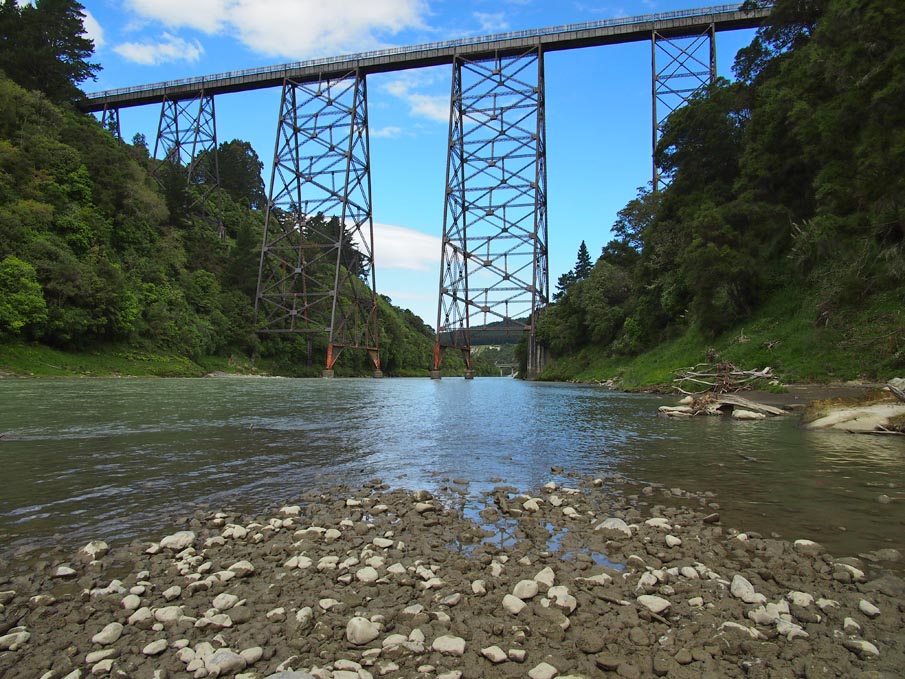
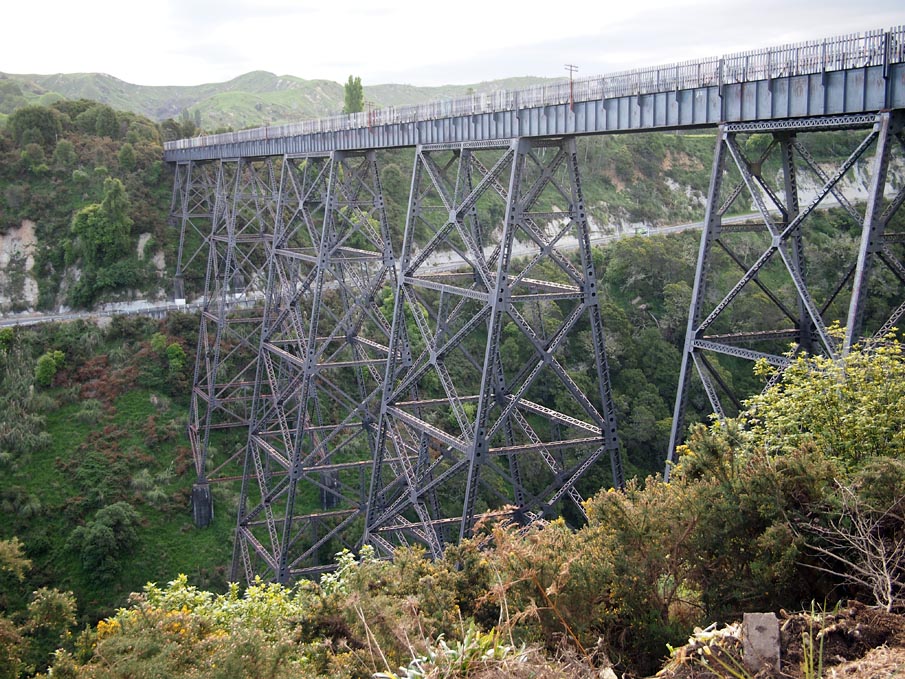
The Mohaka Viaduct was built over the Mohaka River, near Raupunga, Wairoa, between 1930 and 1937. It soars nearly one hundred metres above the river surface and is the tallest viaduct in Australasia
From at least the late nineteenth century there had been attempts to construct a railway connecting Gisborne with Napier. The difficult terrain between the two settlements made the New Zealand Government, the principal investor in the country's railway network, reluctant to invest money on such a project. In addition, Maori landowners were unwilling to sell their land for the railway. In 1900 a railway league was formed to advocate for lines to Auckland via Rotorua and a line connecting Wellington to Wairoa. It was not until 1911 that the latter line was approved and work began in 1912. Construction on the new railway was halted during the First World War. During the 1920s further delays were caused by a debate on whether to go by the coastal route or inland. Finally in about 1928 a decision was made to build the railway along the coastal route and work recommenced.
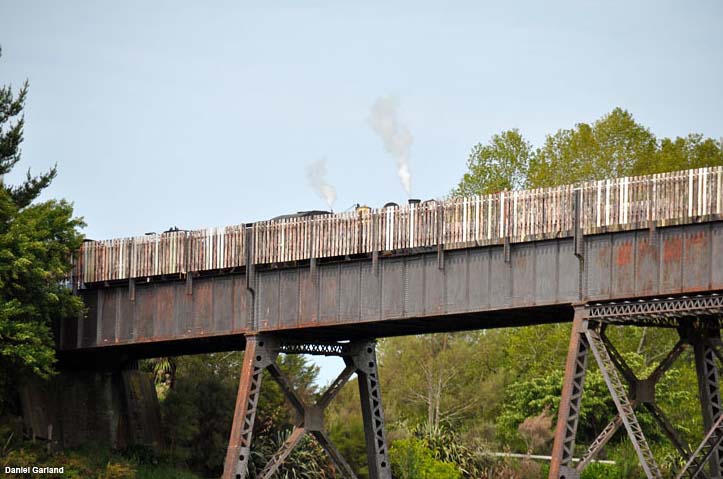
The Mohaka Viaduct was designed by New Zealand-born engineer John E. L. Cull (1878-1943). Educated in Christchurch and London, Cull had held various positions including university lecturer and assisting local bodies, before being appointed in 1914 as the first designing engineer for the Public Works Department. Cull's design for the viaduct called for a bridge 277 metres in length, 95 metres high, supported by five piers/towers. To protect the viaduct and the trains from the wind, a stout windbreak was designed to be placed above the girders. Cull resigned in 1929 and William Newnham (1888-1974), who had previously been employed by Public Works as assistant to the design engineer, took over the project. (Newnham was later appointed Engineer-in-Chief and Under Secretary of Public Works in 1941.)
In 1931 the Railways Board, the body that controlled the construction of railway throughout New Zealand, recommended that, due to the economic conditions brought on by the Great Depression, work on the track be stopped. By this stage the foundations of the viaduct had been completed, and the iron and steelwork, which had been prefabricated at the Railways Department workshops, Tauranga, had been transported to the site.
In 1935 the first Labour Government was elected. Labour saw the State as having a key role in reinvigorating the economy through government initiated public works. In 1936 the government introduced the Government Railways Amendment Act ending the Railways Board, and from 1 April 1936 control of the railways reverted to the government through the Minister of Railways. Work on the Napier-Wairoa-Gisborne line was resumed in that same year. On 31 June 1937, at a ceremony attended by the Minister of Railways, the Leader of the House of Representatives, and a number of community dignitaries, the Minster of Public Works, Robert Semple (1873-1958) drove that last spike in on the viaduct. The remaining line between Wairoa and Gisborne was not completed until August 1942. The line was officially handed over by Public Works to the New Zealand Railways Department on 1 February 1943.
The Mohaka Viaduct has great technical significance as the tallest viaduct in Australasia. It is an impressive engineering feat constructed of prefabricated steel components made by the Public Works Department. Constructed largely in the wake of the Depression, the Mohaka Viaduct was an important factor in the completion of the railway line, which opened up Northern Hawke's Bay and Poverty Bay, reducing the isolation of Wairoa and, to a lesser extent, Gisborne. Sited above the Mohaka River and above State Highway 2, this imposing viaduct is a renowned local landmark.
From at least the late nineteenth century there had been attempts to construct a railway connecting Gisborne with Napier. The difficult terrain between the two settlements made the New Zealand Government, the principal investor in the country's railway network, reluctant to invest money on such a project. In addition, Maori landowners were unwilling to sell their land for the railway. In 1900 a railway league was formed to advocate for lines to Auckland via Rotorua and a line connecting Wellington to Wairoa. It was not until 1911 that the latter line was approved and work began in 1912. Construction on the new railway was halted during the First World War. During the 1920s further delays were caused by a debate on whether to go by the coastal route or inland. Finally in about 1928 a decision was made to build the railway along the coastal route and work recommenced.
The Mohaka Viaduct was designed by New Zealand-born engineer John E. L. Cull (1878-1943). Educated in Christchurch and London, Cull had held various positions including university lecturer and assisting local bodies, before being appointed in 1914 as the first designing engineer for the Public Works Department. Cull's design for the viaduct called for a bridge 277 metres in length, 95 metres high, supported by five piers/towers. To protect the viaduct and the trains from the wind, a stout windbreak was designed to be placed above the girders. Cull resigned in 1929 and William Newnham (1888-1974), who had previously been employed by Public Works as assistant to the design engineer, took over the project. (Newnham was later appointed Engineer-in-Chief and Under Secretary of Public Works in 1941.)
In 1931 the Railways Board, the body that controlled the construction of railway throughout New Zealand, recommended that, due to the economic conditions brought on by the Great Depression, work on the track be stopped. By this stage the foundations of the viaduct had been completed, and the iron and steelwork, which had been prefabricated at the Railways Department workshops, Tauranga, had been transported to the site.
In 1935 the first Labour Government was elected. Labour saw the State as having a key role in reinvigorating the economy through government initiated public works. In 1936 the government introduced the Government Railways Amendment Act ending the Railways Board, and from 1 April 1936 control of the railways reverted to the government through the Minister of Railways. Work on the Napier-Wairoa-Gisborne line was resumed in that same year. On 31 June 1937, at a ceremony attended by the Minister of Railways, the Leader of the House of Representatives, and a number of community dignitaries, the Minster of Public Works, Robert Semple (1873-1958) drove that last spike in on the viaduct. The remaining line between Wairoa and Gisborne was not completed until August 1942. The line was officially handed over by Public Works to the New Zealand Railways Department on 1 February 1943.
The Mohaka Viaduct has great technical significance as the tallest viaduct in Australasia. It is an impressive engineering feat constructed of prefabricated steel components made by the Public Works Department. Constructed largely in the wake of the Depression, the Mohaka Viaduct was an important factor in the completion of the railway line, which opened up Northern Hawke's Bay and Poverty Bay, reducing the isolation of Wairoa and, to a lesser extent, Gisborne. Sited above the Mohaka River and above State Highway 2, this imposing viaduct is a renowned local landmark.